24 June 2026 · 00:43:47
Whales Are Our Ancestors - Dr. Mere Takoko on Legal Personhood for Whales
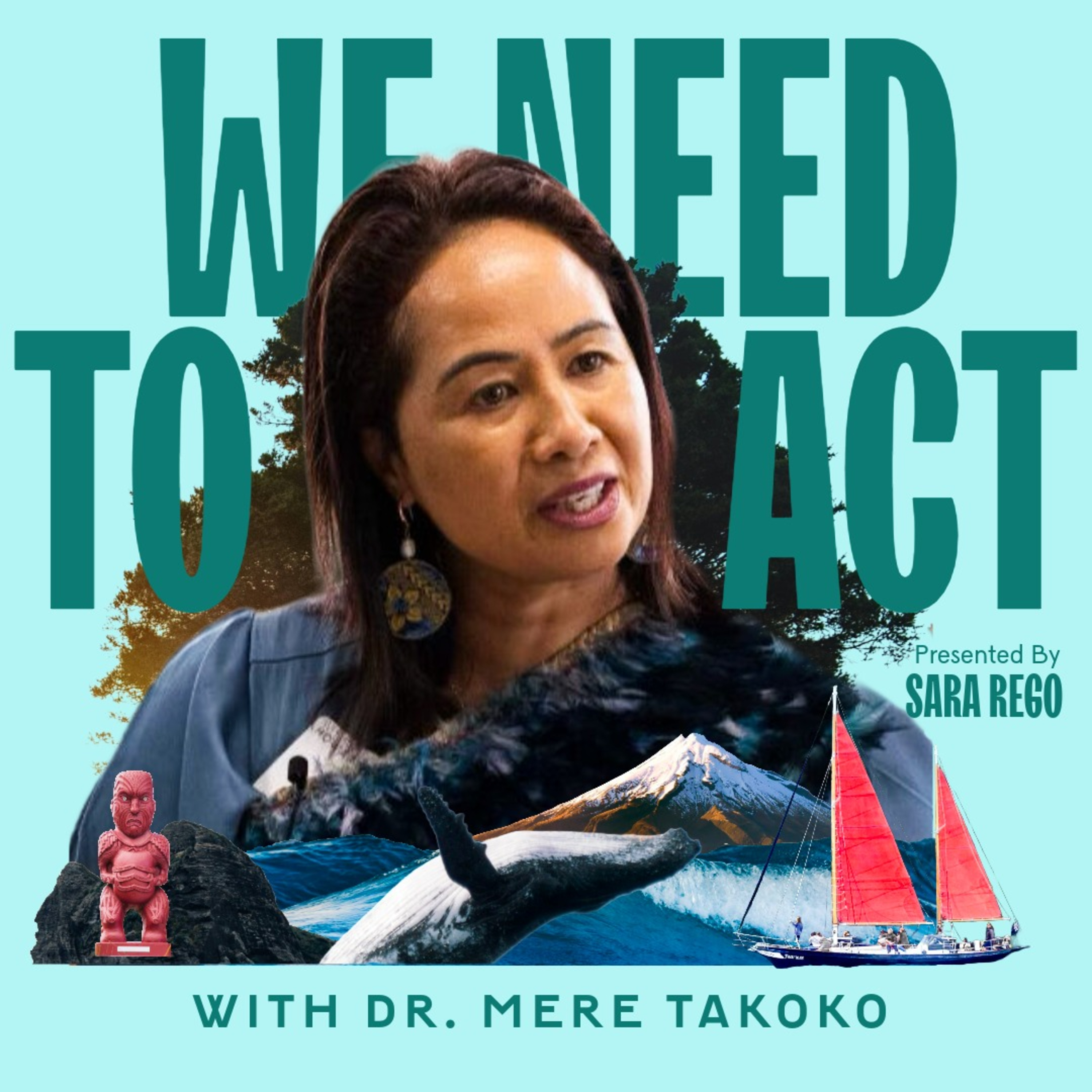
Episode 57 · 00:43:47
Whales Are Our Ancestors - Dr. Mere Takoko on Legal Personhood for Whales
Show notes
What if whales are not just animals — but ancestors?
Dr. Mere Takoko is a Māori Ocean and Climate conservationist from Aotearoa New Zealand and one of the leading voices behind the movement to grant whales legal personhood across the Pacific. A descendant of Māui and Paikea — the ancestor who arrived in New Zealand on the back of a whale — Mere holds what she describes not as a job, but an inherited sovereign duty: to protect her ancestors and rebuild the relationship between people and nature.
In this conversation with Sara, Mere explains why whales are the ocean's greatest climate engineers — each one capable of storing the carbon equivalent of over a thousand trees — and why restoring one million whales to the Pacific is not just an ecological goal, but a cultural and spiritual one.
She talks about authoring He Whakaputanga Moana, the declaration that confers legal personhood on whales under customary law, signed by paramount chiefs across Polynesia and championed by the late Māori King. She speaks candidly about the rise of "blue colonialism" — large conservation organisations moving into the Pacific and absorbing resources that rarely reach the Indigenous communities doing the actual work. And she shares her quiet concern about artificial intelligence falling into the wrong hands in the race to "communicate" with whales.
But beneath the critique is something rarer: a genuinely different way of seeing. Not nature as resource. Not whales as biomass. Kinship. Ancestry. A 22-generation-old covenant still being honoured today.
In this episode:
- Why whales are the ocean's most powerful climate engineers — and what industrial whaling really cost the planet
- The whale fall, the whale pump, and the science behind whale-driven carbon capture
- He Whakaputanga Moana: the declaration granting whales legal personhood across the Pacific
- The Āvei Moana voyage — a two-year, 6,000-mile expedition to protect ancestral sea roads
- "Blue colonialism": why conservation finance rarely reaches the Indigenous communities doing the work
- The concerns Pacific communities have about AI being used to "communicate" with — or control — whales
- Why Mere believes restoring the relationship between people and nature is the real climate solution
About Dr. Mere Takoko:
Dr. Mere Takoko is a Māori conservationist of Ngāti Porou, Te Whānau-a-Apanui, and Rongowhakaata descent, and Executive Trustee of the Moananui Sanctuary. She is the author of He Whakaputanga Moana, the declaration granting legal personhood to whales across the Polynesian triangle, and Chief Executive of the Pacific Whale Fund, where she is leading efforts to establish a US$100 million biodiversity blue bond for marine conservation. A descendant of Māui and Paikea, Mere leads a global effort to recover one million whales across the Pacific.
More episodes

Ep. 67
The True Cost of Fashion and Why We Need to Buy Less with Claudia Pievani
Fashion is broken. Can beauty fix it? In this episode of We Need to Act, Sara Rego speaks with Claudia Pievani, founder of Miomojo — an upper premium, cruelty-free Italian accessories brand and certified B Corp. Fashion is one of the most polluting industries on the planet. It exploits animals, unde

Ep. 66
The Ocean Won't Die But We Might: Indigenous Knowledge, Ocean Health & Youth Leadership with Bodhi Patil
The ocean is dying. Do we have the answers? In this episode of We Need to Act, Sara Rego speaks with Bodhi Patil, ocean guardian, founder of Inner Light and co-founder of Ocean Uprise. The ocean produces roughly half the oxygen we breathe and absorbs nearly a third of the CO2 we emit. And yet it rem
Ep. 65
Tuvalu Is Fighting to Survive: Climate Change, Rising Seas & Climate Justice | Dr. Tapugao Falefou
Tuvalu is living the climate crisis now. In this episode of We Need to Act, Sara Rego speaks with Dr. Tapugao Falefou, Tuvalu’s Permanent Representative to the United Nations and Ambassador to the United States and the Republic of Cuba. For Tuvalu, climate change is not a distant threat. Rising sea