23 July 2026 · 00:28:49
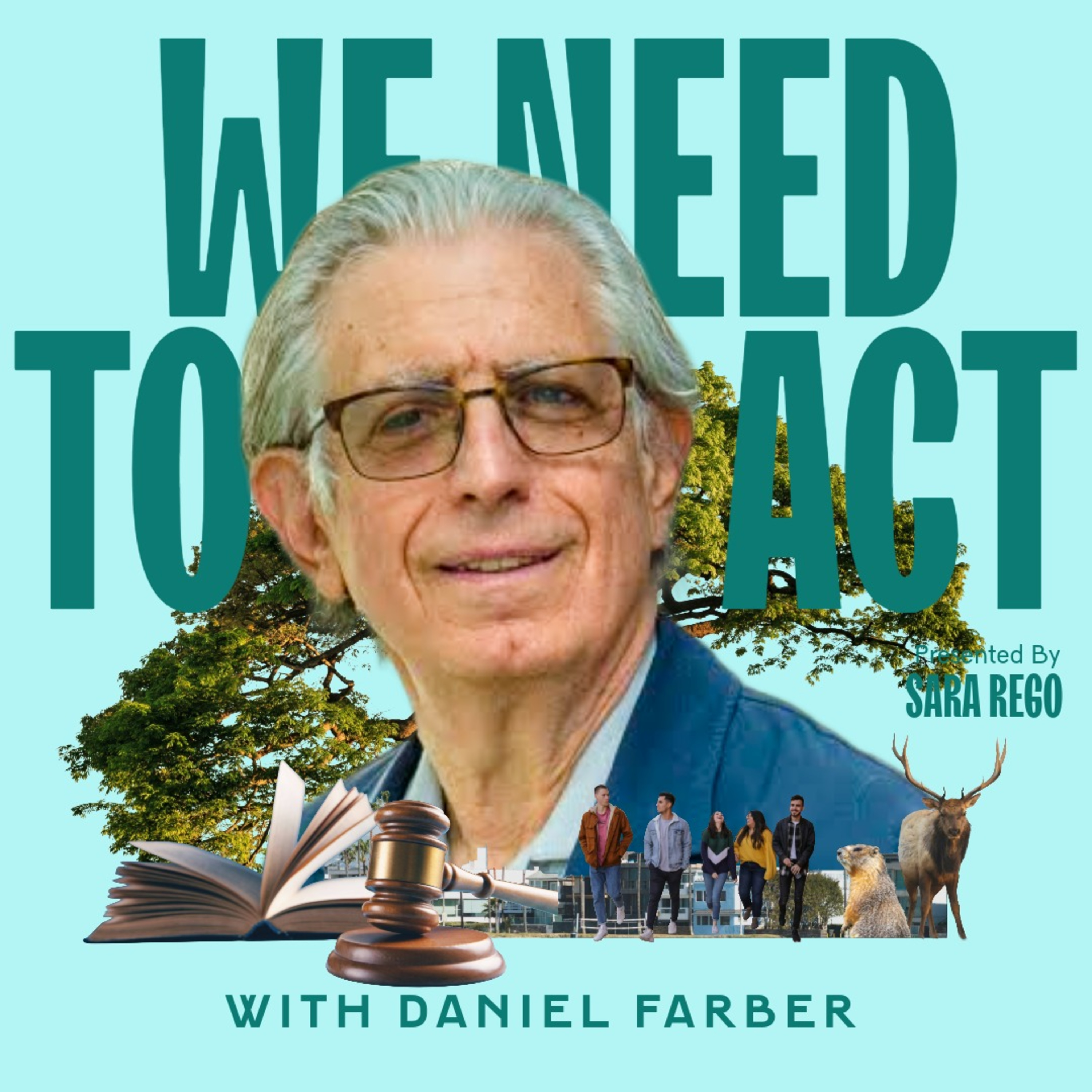
Environmental Law and Climate Change: Why Collective Action Is Our Most Powerful Tool with Daniel Farber
Guest: Daniel Farber
Episode 61 · 00:28:49
Environmental Law and Climate Change: Why Collective Action Is Our Most Powerful Tool with Daniel Farber
Show notes
What happens to environmental law when the federal government turns its back on climate action?
Dan Farber is the Sho Sato Professor of Law at UC Berkeley and one of the most respected voices in US environmental and constitutional law. A former law clerk to Justice John Paul Stevens of the US Supreme Court, he has spent decades at the intersection of environmental policy, democracy, and justice.
In this conversation with Sara, Dan offers a clear-eyed and surprisingly hopeful assessment of where we are. He talks about why simply limiting emissions is no longer enough — and why we need to think seriously about what we are going to build in place of the fossil fuel world. He talks about the role of state governments as the real drivers of durable climate action in the US, and about why California and other states are effectively doing the lab work for the federal government. He speaks about environmental justice — who is most exposed to risk, who is most vulnerable, and why those two things are not always the same. And he addresses political polarisation head-on, arguing that climate change was never and should never be a left-right issue.
But the most important message he leaves is this: change is not all or nothing. Every ton of carbon we stop emitting makes the world a little bit better. And collectively — in communities, in states, in cities — we are far more powerful than we feel.
In this episode:
- What environmental law actually is — and why companies won't act without it
- Why limiting emissions alone is not enough — the case for investment-led climate policy
- How the war in the Middle East is accelerating the global energy transition
- Why state and local governments are the real engine of durable climate action in the US
- Environmental justice: who is most exposed, who is most vulnerable — and why these aren't the same
- Political polarisation and climate change — how we got here and how we get past it
- Why democracy, despite its slowness, produces more durable climate solutions than authoritarianism
- What ordinary citizens can actually do — from voting with their wallet to writing to their state legislators
- Why community is the antidote to powerlessness
About Dan Farber:
Dan Farber is the Sho Sato Professor of Law at the University of California, Berkeley, where he leads two research centres focused on law, energy, environment, and democracy. A former law clerk to Justice John Paul Stevens of the US Supreme Court, he is a member of the American Academy of Arts and Sciences and the author of several influential books including Eco-Pragmatism and Contested Ground: How to Understand the Limits on Presidential Power.
We Need to Act is a podcast about the people, ideas, and movements shaping a better now.
More episodes

Ep. 67
The True Cost of Fashion and Why We Need to Buy Less with Claudia Pievani
Fashion is broken. Can beauty fix it? In this episode of We Need to Act, Sara Rego speaks with Claudia Pievani, founder of Miomojo — an upper premium, cruelty-free Italian accessories brand and certified B Corp. Fashion is one of the most polluting industries on the planet. It exploits animals, unde

Ep. 66
The Ocean Won't Die But We Might: Indigenous Knowledge, Ocean Health & Youth Leadership with Bodhi Patil
The ocean is dying. Do we have the answers? In this episode of We Need to Act, Sara Rego speaks with Bodhi Patil, ocean guardian, founder of Inner Light and co-founder of Ocean Uprise. The ocean produces roughly half the oxygen we breathe and absorbs nearly a third of the CO2 we emit. And yet it rem
Ep. 65
Tuvalu Is Fighting to Survive: Climate Change, Rising Seas & Climate Justice | Dr. Tapugao Falefou
Tuvalu is living the climate crisis now. In this episode of We Need to Act, Sara Rego speaks with Dr. Tapugao Falefou, Tuvalu’s Permanent Representative to the United Nations and Ambassador to the United States and the Republic of Cuba. For Tuvalu, climate change is not a distant threat. Rising sea